 Vortia 3D
Case study: dust extraction in a joinery workshop
Published on by Raul Rodríguez
Four machines, a bag filter and a centrifugal fan. In chip extraction, noise and pressure drop are not what matters most: what matters is that the air moves fast enough for the sawdust not to settle in the duct. It is the “Joinery workshop” example in the app.
1. The starting point
| Machine | Airflow | Opening |
|---|---|---|
| Circular saw | 800 m³/h | Flanged, 200 × 200 mm |
| Spindle moulder | 900 m³/h | Flanged, 200 × 200 mm |
| Thicknesser | 1,300 m³/h | Flanged, 250 × 250 mm |
| Planer | 1,100 m³/h | Flanged, 250 × 250 mm |
Typical catalogue airflows for industrial woodworking machines. Total: 4,100 m³/h.
A Ø315 main runs across the workshop and Ø200 drops come down from it to each machine. In front of the fan there is a bag filter with a 900 Pa pressure drop at its nominal airflow: it goes into the app as a “Fitting (known ΔP)”, with the manufacturer’s figure.
In “Installation”, the contaminant is “Heavy dust (chips, sand)”: ACGIH requires at least 20 m/s along the whole route. Wood dust is combustible, so ATEX is also ticked.
2. First calculation: the sawdust settles in the duct
| Machine | Needs | Receives | Deviation |
|---|---|---|---|
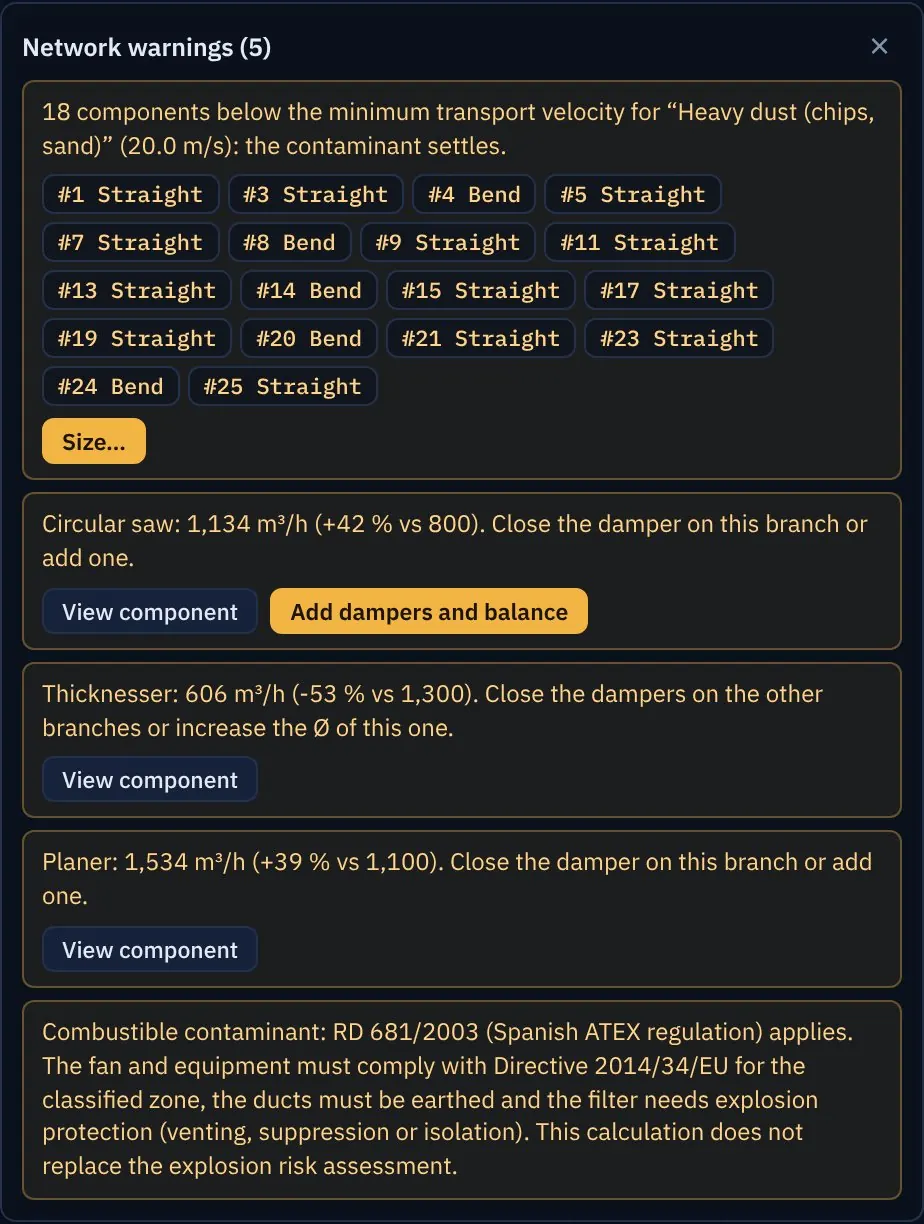
| Circular saw | 800 m³/h | 1,134 m³/h | +42 % |
| Spindle moulder | 900 m³/h | 826 m³/h | -8 % |
| Thicknesser | 1,300 m³/h | 606 m³/h | -53 % |
| Planer | 1,100 m³/h | 1,534 m³/h | +39 % |
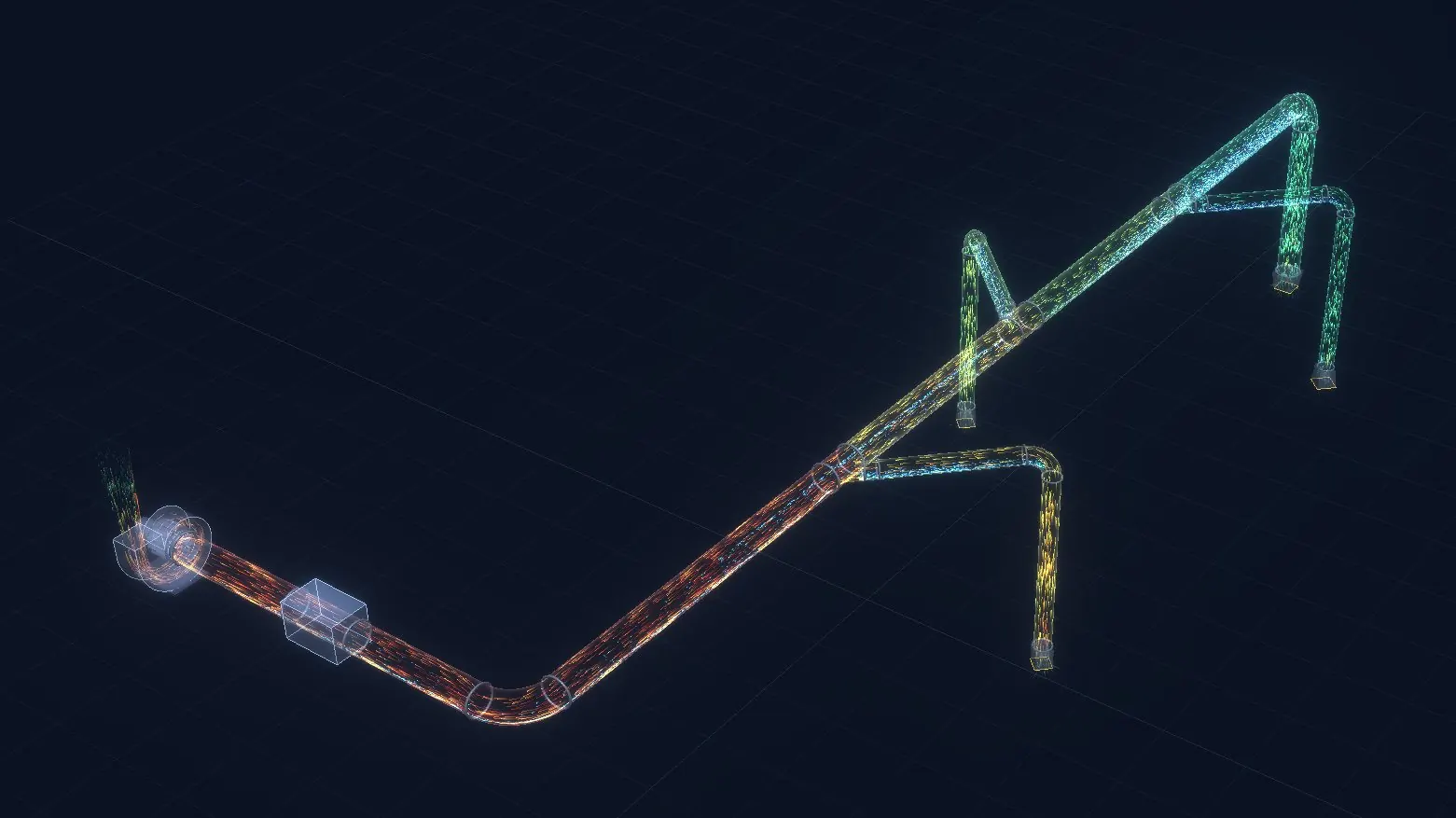
The air moves at between 5.4 m/s (the final run) and 14.6 m/s (the main): no component reaches 20 m/s. In the 3D view the sawdust can be seen dragging along the bottom of the horizontal runs. On top of that, the Thicknesser receives less than half of what it needs and the Saw and the Planer get 40 % too much.
The transport velocity warnings are grouped into one, with a button per component to view it in 3D and another to size the network:
3. Sizing for the transport velocity
In industrial extraction, “Size the network” proposes the minimum transport velocity criterion by default: on each run, the largest Ø that keeps 20 m/s. Any larger and the sawdust settles; any smaller only adds pressure drop.
- Main from Ø315 to Ø250, with three reducers as the airflow falls: Ø224, Ø200 and Ø125 at the Planer.
- Drops from Ø200 to Ø112 (Saw), Ø125 (Spindle moulder) and Ø140 (Thicknesser).
All components now run at between 19.2 and 25.3 m/s. The fan goes from 1,184 to 2,169 Pa: moving fast costs pressure, and it is the price of not having to clean the ducts.
4. Balancing the dampers
One damper on each drop and another on the final run. “Balance dampers” closes them just enough for each machine to get its airflow:
| Machine | Needs | Balanced | Deviation | Drop | Damper |
|---|---|---|---|---|---|
| Circular saw | 800 m³/h | 799 m³/h | -0.1 % | Ø112 | 19.5° |
| Spindle moulder | 900 m³/h | 902 m³/h | +0.2 % | Ø125 | 21° |
| Thicknesser | 1,300 m³/h | 1,303 m³/h | +0.2 % | Ø140 | 1.5° |
| Planer | 1,100 m³/h | 1,097 m³/h | -0.3 % | Ø125 | 0° |
Maximum error of 0.3 % and velocities between 20.4 and 24.8 m/s. The Planer, at the end of the main, stays open: it is the index branch. The fan needs 2,428 Pa.
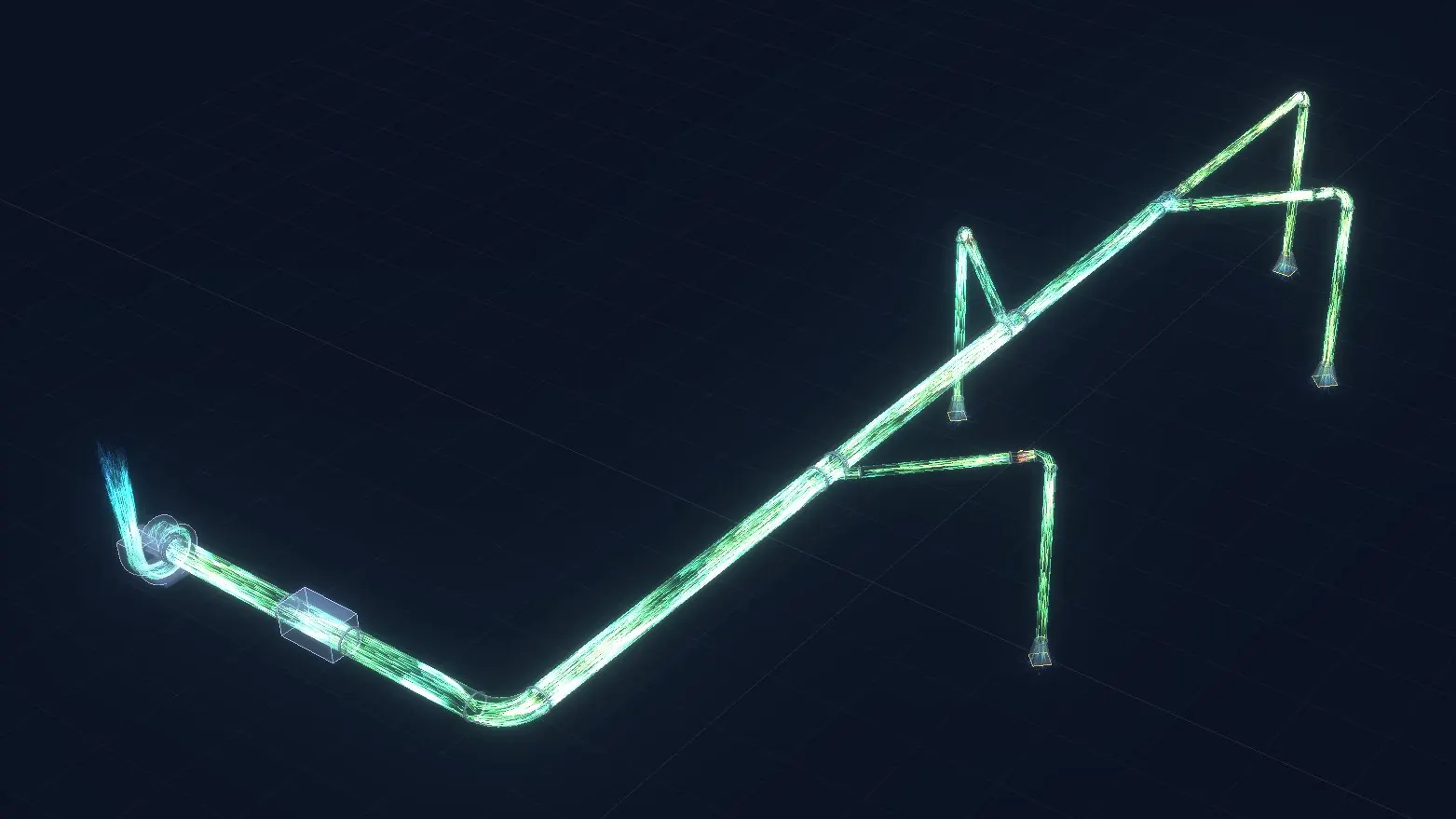
In joinery workshops, machines that are not running are usually shut off completely. With fewer machines open, the velocity rises in their drops and falls in the main: it is worth also calculating the real diversity (open the project, remove the target airflow of the machines that are off and look at the velocities).
5. Fan and filter
- Duty point: 4,155 m³/h (4,100 plus 55 of leakage) at 2,428 Pa. It is a medium-pressure centrifugal fan.
- Pressure breakdown: the filter takes 900 Pa (37 %); each opening, between 120 and 180 Pa (ACGIH coefficient 0.49 on around 290 Pa of velocity pressure).
- Electrical power: 4.7 kW with 70 % fan efficiency and 85 % for motor and drive.
- Noise reaching the workshop through the ducts: 65–67 dB(A), below 80 dB(A) (Spanish RD 286/2006 on workplace noise). Noise from the machines and the fan itself is separate.
The specific fan power (SFP) of EN 16798-3 is for ventilation in buildings: in this example the limit is set at “SFP 7”, with no requirement.
6. ATEX
With the dust marked as combustible, the app recalls what the Spanish ATEX regulation (RD 681/2003) requires: fan and equipment to Directive 2014/34/EU for the classified zone, ducts earthed and explosion protection for the filter (venting, suppression or isolation). The explosion risk assessment is a separate document.
Summary
| Step | Fan pressure | Velocity along the route | Maximum airflow deviation |
|---|---|---|---|
| First calculation | 1,184 Pa | 5.4–14.6 m/s | 53 % |
| Sizing | 2,169 Pa | 19.2–25.3 m/s | 15 % |
| Balancing | 2,428 Pa | 20.4–24.8 m/s | 0.3 % |