 Vortia 3D
Case study: dwelling ventilation (Spanish CTE DB-HS 3)
Published on by Raul Rodríguez
A 3-bedroom dwelling with mechanical ventilation: air comes in through the bedrooms and living room and leaves through the kitchen and the two bathrooms, with an extract fan in the corridor ceiling void. It is the “Dwelling” example in the app.
1. The DB-HS 3 airflows
Table 2.1 of the Spanish Building Code’s indoor air quality document (CTE DB-HS 3) gives, for a dwelling with 3 or more bedrooms:
| Room | Minimum airflow |
|---|---|
| Main bedroom | 8 l/s |
| Other bedrooms (2) | 4 l/s each |
| Living-dining room | 10 l/s |
| Wet rooms | 33 l/s in total and 8 l/s per room |
Supply: 8 + 4 + 4 + 10 = 26 l/s. Extract: 33 l/s. The larger value is used for the design.
33 l/s, 120 m³/h is extracted: 48 m³/h (13.3 l/s) in the kitchen and 36 m³/h (10 l/s) in each bathroom, all above the 8 l/s per room. The extract valves need an effective area of at least 4·qv cm² (table 4.1): 40 cm² in the bathrooms and 53 cm² in the kitchen. The cooker hood is separate: at least 50 l/s through a duct independent of the general ventilation, with a grease filter (sections 2, 3.1.1 and 3.2.5).
In the app: extract mode, “Residential” use, “Ventilation air” as the contaminant (no transport or capture velocity) and ceiling valves with 20 Pa at their airflow. As it runs at night, the noise is compared with the night-time limit: 30 dB(A) in living spaces. Table B2 of the Spanish noise regulation RD 1367/2007 sets no limit for bathrooms; the living-space limit is used as a reference.
2. First calculation: everything in Ø100
With the whole duct in Ø100, the first run moves at 4.2 m/s. DB-HS 3 (section 4.2.2) requires a section S ≥ 2.5·qvt in ducts next to habitable rooms: with 33 l/s that is 82.5 cm², and a Ø100 has 78.5 cm². In other words, 4 m/s at most.
- Bathroom 2, the closest to the fan: 43 m³/h, 19 % too much.
- Kitchen, at the end: 42 m³/h, 12 % too little.
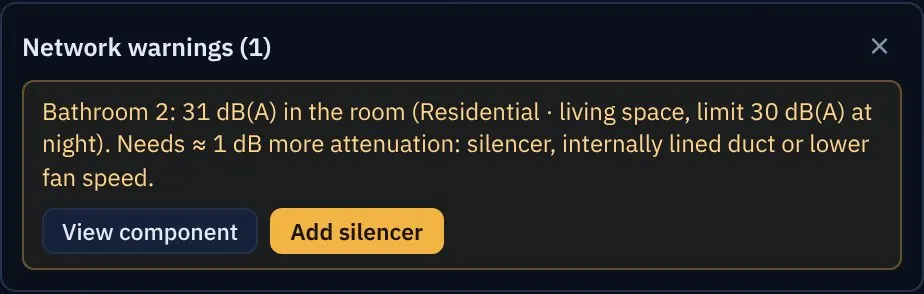
- Noise in Bathroom 2: 31 dB(A), 1 dB above the night-time limit.
3. Sizing
“Size the network” with the residential values (4 m/s in the main and 3 m/s in the branches) leaves the first run at Ø112 (98.5 cm², 3.4 m/s); the duct then steps down to Ø90 and Ø80 with two reducers and the bathroom spigots end up at Ø80. Run by run: Ø112 (98.5 cm²) for 33 l/s requires 82.5; Ø90 (63.6 cm²) for 23.3 l/s requires 58.3; Ø80 (50.3 cm²) for 13.3 l/s requires 33.3. Everything meets formula 4.1.
4. Adjustable valves
Extract valves are adjustable: in the app, a damper on each spigot. “Balance dampers” sets them: 40° in Bathroom 2, 31° in Bathroom 1 and the kitchen open. Each room receives its airflow with a 0.2 % error and the extract fan needs 62 Pa.
5. Night-time noise: a small silencer
The noise in Bathroom 2 is still 31 dB(A). The warning comes with the fix:
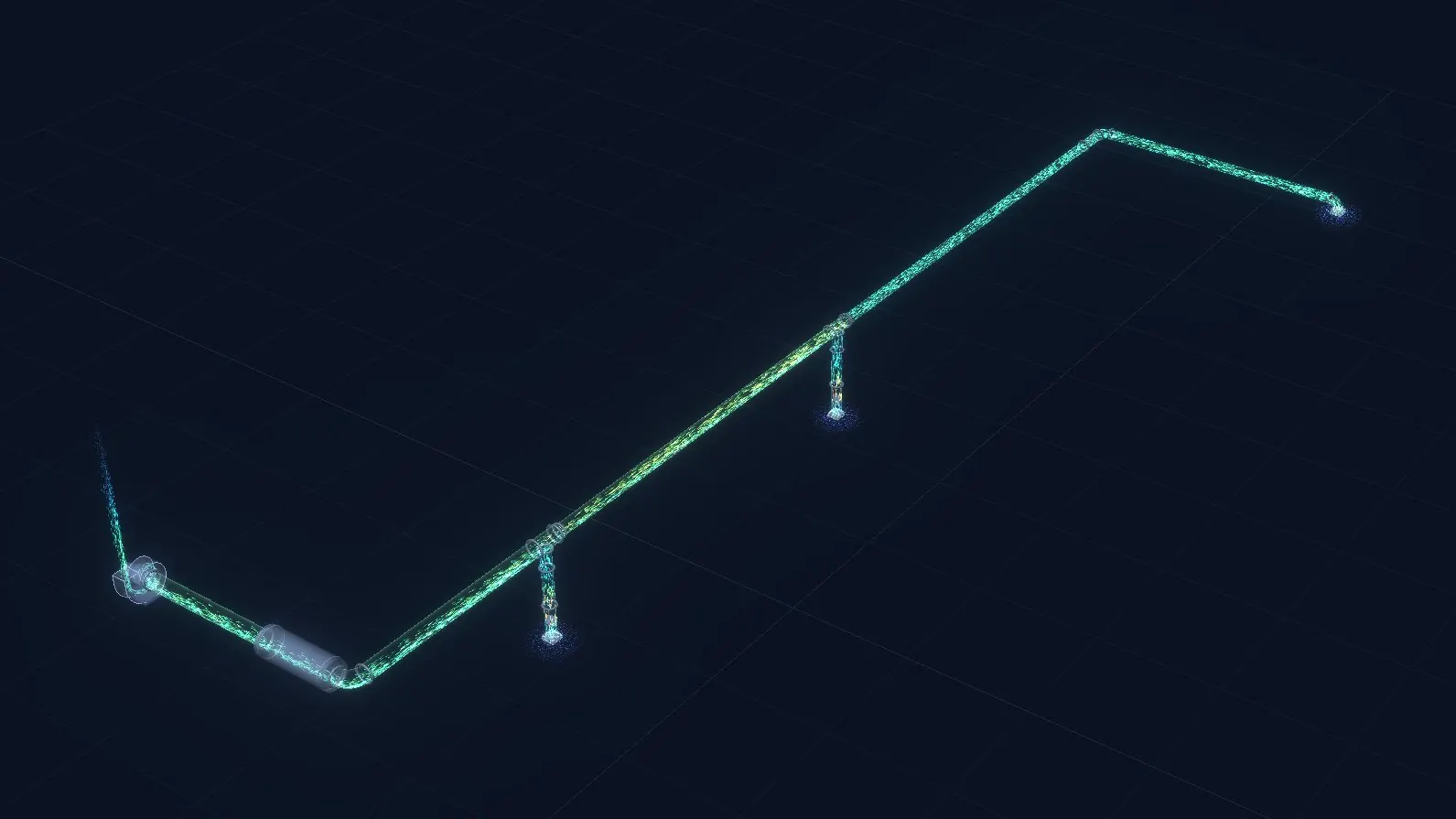
The app proposes a 0.6 m circular silencer with 50 mm of absorbent, just after the first run: it attenuates around 20 dB between 500 and 2,000 Hz with only 2 Pa of pressure drop. The noise reaching the three rooms through the ducts drops to 12–13 dB(A).
In dwellings, the noise radiated by the fan casing in the ceiling void also counts. The app only calculates what reaches the rooms through the ducts: choose a quiet extract fan and mount it on anti-vibration supports.
Summary
| Step | First run | Maximum airflow deviation | Maximum noise (night) |
|---|---|---|---|
| First calculation | Ø100 · 4.2 m/s | 19 % | 31 dB(A) |
| Sizing | Ø112 · 3.4 m/s | 25 % | 30 dB(A) |
| Valves balanced | Ø112 · 3.4 m/s | 0.2 % | 31 dB(A) |
| Silencer | Ø112 · 3.4 m/s | 0.2 % | 13 dB(A) |